
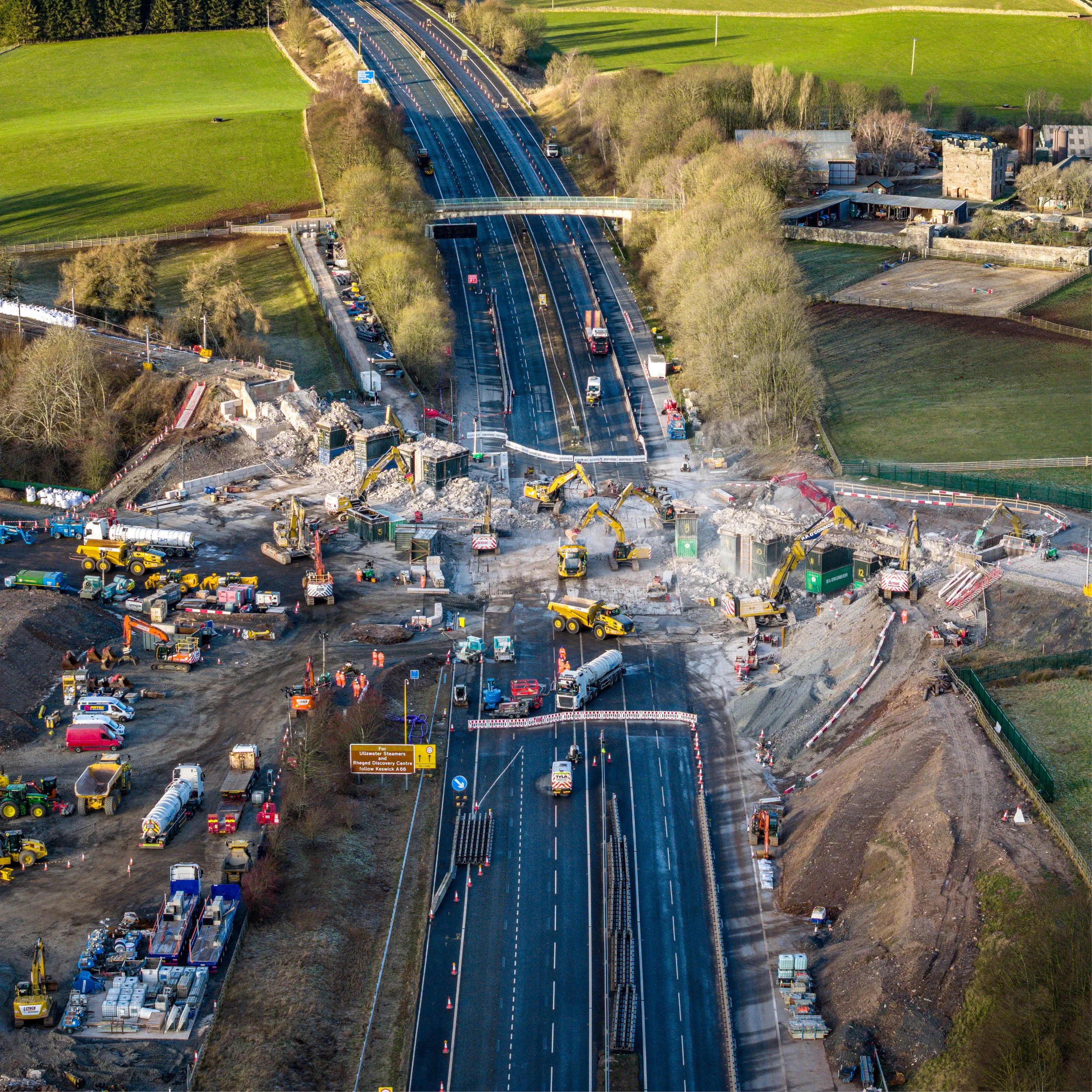
Clifton Bridge demolition, M6, Cumbria
Winner of the Civils Demolition Award and Best of the Best at the 2026 World Demolition Awards.
Clifton Bridge achieved the highest score across all entries. The judges highlighted the quality of execution and overall project control, describing the scheme as “outstanding and a strong example of best practice.”

Armac Demolition removed a 140-metre railway bridge over the M6 near Penrith in a single weekend closure. The existing piers and bearing shelves were preserved for reuse, allowing the replacement bridge to be installed the following weekend as planned.
Project
At a glance
Client
Network Rail
Principal Contractor
Skanska
Armac’s scope
Early contractor involvement, demolition engineering, temporary works and specialist demolition
Structure
140-metre, three-span post-tensioned concrete railway bridge
Demolition window
2–5 January 2026, during a single full M6 closure within a West Coast Main Line possession
The challenge
Clifton Bridge had deteriorated to the point that only one train could cross it at a time. Its removal was a critical step in the replacement programme. Within one full M6 closure, Armac had to complete the temporary support installation, dismantle the bridge, clear the carriageway and hand it back for reopening. The existing piers and bearing shelves had to be protected throughout so they could support the new structure.
Incomplete as-built records and defects in the tendon grouting made it difficult to predict how the bridge would behave as the forces in its post-tensioning system were released. The demolition method had to maintain stability at each stage and allow the team to respond safely to conditions uncovered on site.
Developing the demolition method
Armac joined the project during early contractor involvement, working with Skanska, Network Rail and the design team to assess demolition options, test their feasibility and inform the target cost. That early work brought structural engineering, temporary works and site logistics into the same plan. Advance rail possessions allowed enabling and protection works to be brought forward, making more of the motorway closure available for demolition and clearance.
The team developed temporary support towers from repurposed ISO shipping containers and verified their performance through full-scale compression testing. Hydraulic jacks transferred the bridge loads from the existing bearings onto the towers. This allowed the team to release the post-tensioning forces in stages while protecting the retained substructure. Independent Category III design checks, structural monitoring and formal engineering hold points provided assurance at critical stages.
Delivering within the closure
Armac planned the operation hour by hour, from installing carriageway protection through to inspection and handback. Excavators and support plant worked in predefined zones, allowing dismantling, loading and material removal to progress in parallel. Spare plant, replacement attachments, on-site fitters and a contingency shift were available throughout the critical works.
The team assessed more than 70 potential contingency scenarios, covering engineering, plant and environmental risks. A dedicated water supply kept dust suppression running in winter conditions, while runoff was captured and treated to protect the nearby River Lowther.
Adapting to what the team found on site
Intrusive investigations identified additional unreinforced joints and showed that the superstructure was approximately 18% heavier than the design team had assumed. Both findings affected how the bridge could be supported and dismantled. Armac paused the works while the project team reassessed the structure, revised the temporary works and adjusted the demolition sequence. Work resumed after the revised method had been checked and approved.
The outcome
Demolition and motorway handback completed within the agreed closure, keeping the replacement scheme on programme.
Existing piers and bearing shelves retained without damage, ready for the new bridge to be installed the following weekend.
Zero reportable incidents, lost-time injuries or pollution incidents recorded during demolition.
Passenger services resumed over the replacement bridge on 15 January 2026. Network Rail project update
“The complex demolition was proactively managed by Armac’s team, ensuring the works were delivered safely and efficiently.”
Joe Bennett, Project Director, Skanska Construction UK Limited